Top Behavioral Interview Questions
Behavioral interview questions are designed to assess how candidates have handled specific situations in the past, as a way to predict future behavior in similar circumstances. These questions delve into a candidate’s past experiences and actions, providing insights into their skills, abilities, and potential fit for the role. Here are some of the top behavioral interview questions often used by employers:
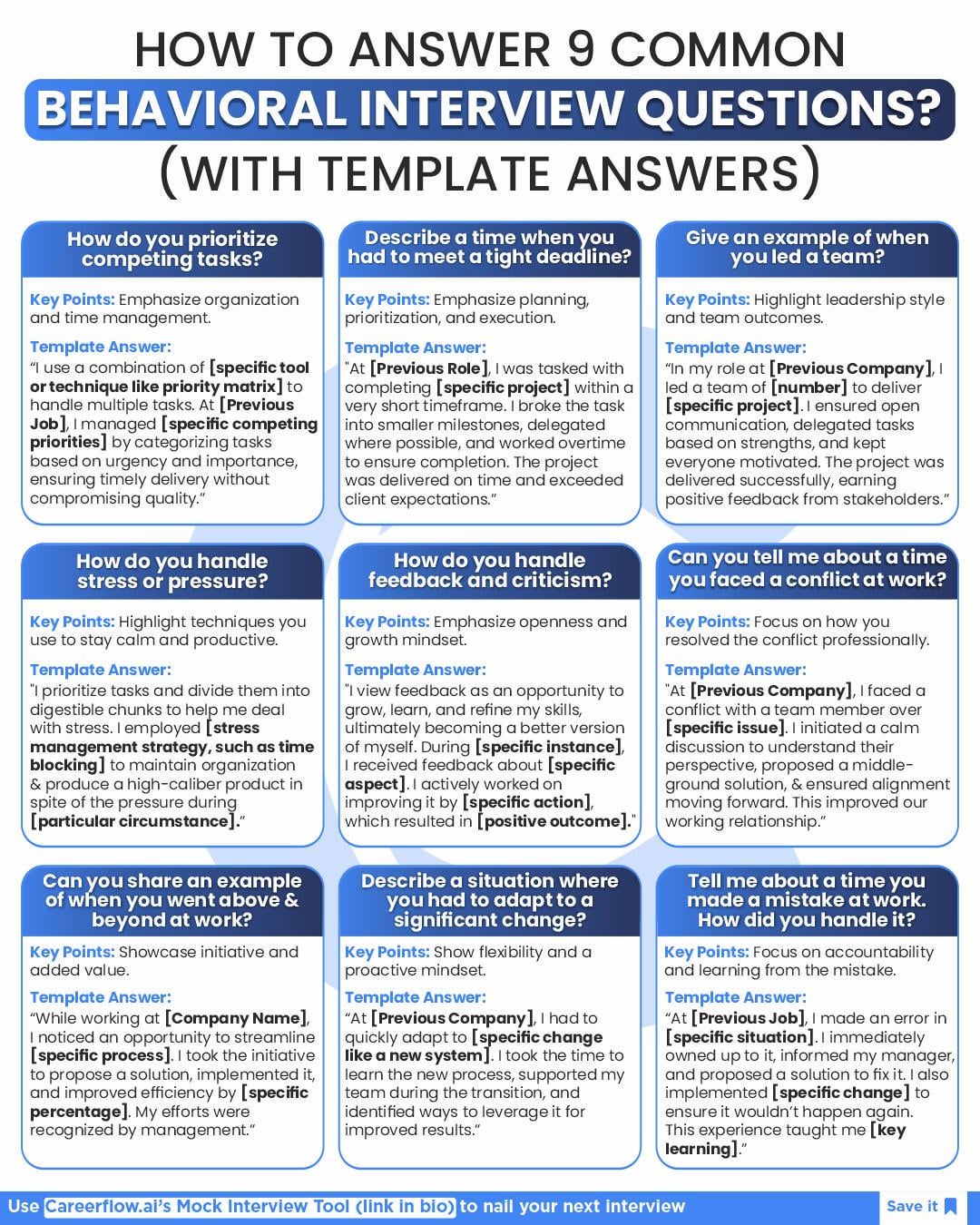
- Can you describe a time when you had to work under pressure or meet a tight deadline? How did you handle it?
- Give an example of a challenging project you worked on. What obstacles did you face, and how did you overcome them?
- Tell me about a time when you had to resolve a conflict with a coworker or team member. How did you approach the situation?
- Describe a situation where you had to adapt to unexpected changes or challenges at work. How did you adjust your approach?
- Can you share an experience where you took the lead on a project or initiative? What was the outcome?
- Give an example of when you had to multitask and prioritize tasks effectively. How did you manage your time?
When preparing for behavioral interviews, it is essential for candidates to reflect on their past experiences and identify specific examples that demonstrate key competencies such as problem-solving, teamwork, leadership, communication, and adaptability. By practicing responses to these types of questions, candidates can showcase their skills and qualifications effectively during the interview process.
Employers use behavioral interview questions not only to evaluate a candidate’s qualifications but also to assess their fit within the company culture and team dynamics. By providing detailed and concrete examples from past experiences, candidates can demonstrate their ability to handle challenges, collaborate with others, and contribute positively to the organization.
Top Behavioral Interview Questions: Key Benefits for Evaluating Candidates
- 1. Provide insight into candidate’s past experiences and actions.
- 2. Predict future behavior in similar work situations.
- 3. Assess candidate’s problem-solving and decision-making skills.
- 4. Evaluate candidate’s ability to work under pressure and handle challenges.
- 5. Help employers gauge candidate’s fit within company culture and team dynamics.
Drawbacks of Top Behavioral Interview Questions: Limited Scope, Lack of Creativity, Potential for Bias, and Time-Consuming Nature
1. Provide insight into candidate’s past experiences and actions.
Behavioral interview questions offer a valuable pro by providing deep insights into a candidate’s past experiences and actions. By prompting candidates to recount specific situations they have encountered in previous roles, these questions allow employers to gain a comprehensive understanding of how candidates have approached challenges, interacted with others, and made decisions in the past. This insight enables employers to assess not only the candidate’s skills and competencies but also their behavior patterns and problem-solving abilities, offering a more holistic view of the candidate’s potential fit for the role.
2. Predict future behavior in similar work situations.
One significant advantage of using top behavioral interview questions is their ability to predict future behavior in similar work situations. By delving into a candidate’s past experiences and actions, employers can gain valuable insights into how the individual is likely to respond to challenges, conflicts, and responsibilities in the future. This predictive aspect allows employers to assess a candidate’s problem-solving skills, decision-making abilities, communication style, and overall fit for the role based on real-life examples rather than hypothetical scenarios. Ultimately, leveraging behavioral interview questions can help organizations make more informed hiring decisions by evaluating how candidates have navigated various work-related situations in the past and extrapolating that information to gauge their potential performance in similar contexts moving forward.
3. Assess candidate’s problem-solving and decision-making skills.
Top behavioral interview questions are beneficial as they effectively assess a candidate’s problem-solving and decision-making skills. By prompting candidates to describe specific instances where they encountered challenges or made critical decisions in the past, employers gain valuable insights into how candidates approach complex situations. This allows employers to evaluate not only the candidate’s ability to solve problems logically and creatively but also their capacity to make sound decisions under pressure. Through these questions, employers can gauge the candidate’s thought process, analytical skills, and strategic thinking abilities, providing a comprehensive view of their problem-solving and decision-making competencies.
4. Evaluate candidate’s ability to work under pressure and handle challenges.
Behavioral interview questions, such as assessing a candidate’s ability to work under pressure and handle challenges, provide valuable insights into an individual’s past experiences and responses in demanding situations. By probing candidates about specific instances where they have faced pressure or overcome obstacles, employers can gauge their resilience, problem-solving skills, and composure in challenging environments. This proactive approach allows recruiters to evaluate how candidates have navigated high-pressure scenarios in the past, providing a glimpse into their potential performance and adaptability within the role.
5. Help employers gauge candidate’s fit within company culture and team dynamics.
Top behavioral interview questions help employers gauge a candidate’s fit within company culture and team dynamics by delving into past experiences that reveal how the candidate interacts with others, approaches challenges, and aligns with the organization’s values. By assessing how candidates have handled situations in the past, employers can gain valuable insights into their communication style, teamwork abilities, and overall compatibility with the company’s ethos. This proactive approach enables employers to make informed hiring decisions that prioritize not only technical skills but also interpersonal qualities that contribute to a harmonious and productive work environment.
1. Limited Scope
Behavioral interview questions, while valuable in assessing a candidate’s past behavior and experiences, have a con in their limited scope. By primarily focusing on past situations, these questions may not always provide a comprehensive understanding of an individual’s potential for future performance or growth within a role. People evolve over time, acquire new skills, and adapt to changing circumstances, which may not be fully reflected in their past experiences. Therefore, relying solely on behavioral interview questions to gauge a candidate’s suitability for a position may overlook their capacity for development and success in new challenges.
2. Lack of Creativity
Candidates may find that one con of top behavioral interview questions is the lack of creativity it imposes. The requirement to draw solely from past experiences may restrict candidates from demonstrating their full potential and diverse skill set. This limitation can hinder candidates who possess innovative thinking or creative problem-solving abilities that may not have been showcased in previous situations. As a result, candidates might feel confined in their responses, potentially overlooking valuable qualities that could contribute significantly to the role they are interviewing for.
3. Potential for Bias
One significant con of using top behavioral interview questions is the potential for bias. Interviewers’ interpretation of candidates’ responses to these questions can be subjective, which may result in unconscious bias influencing the evaluation process. This subjectivity can lead to preconceived notions or stereotypes affecting how interviewers perceive candidates’ experiences and abilities, ultimately impacting their assessment of a candidate’s fit for the role. Addressing and mitigating bias in behavioral interviews is crucial to ensure fair and objective evaluations that focus on candidates’ qualifications and potential contributions without being clouded by unconscious biases.
4. Time-Consuming
Conducting behavioral interviews, while valuable for assessing candidates’ past experiences and behaviors, can be time-consuming. The need for detailed examples and follow-up questions in these interviews can prolong the overall interview process, impacting efficiency. Employers may find themselves spending more time on each candidate to thoroughly evaluate their responses, potentially leading to longer interview sessions and delays in the hiring timeline. Balancing the depth of insight gained from behavioral questions with the need to streamline the interview process is crucial for ensuring a positive candidate experience and efficient hiring practices.