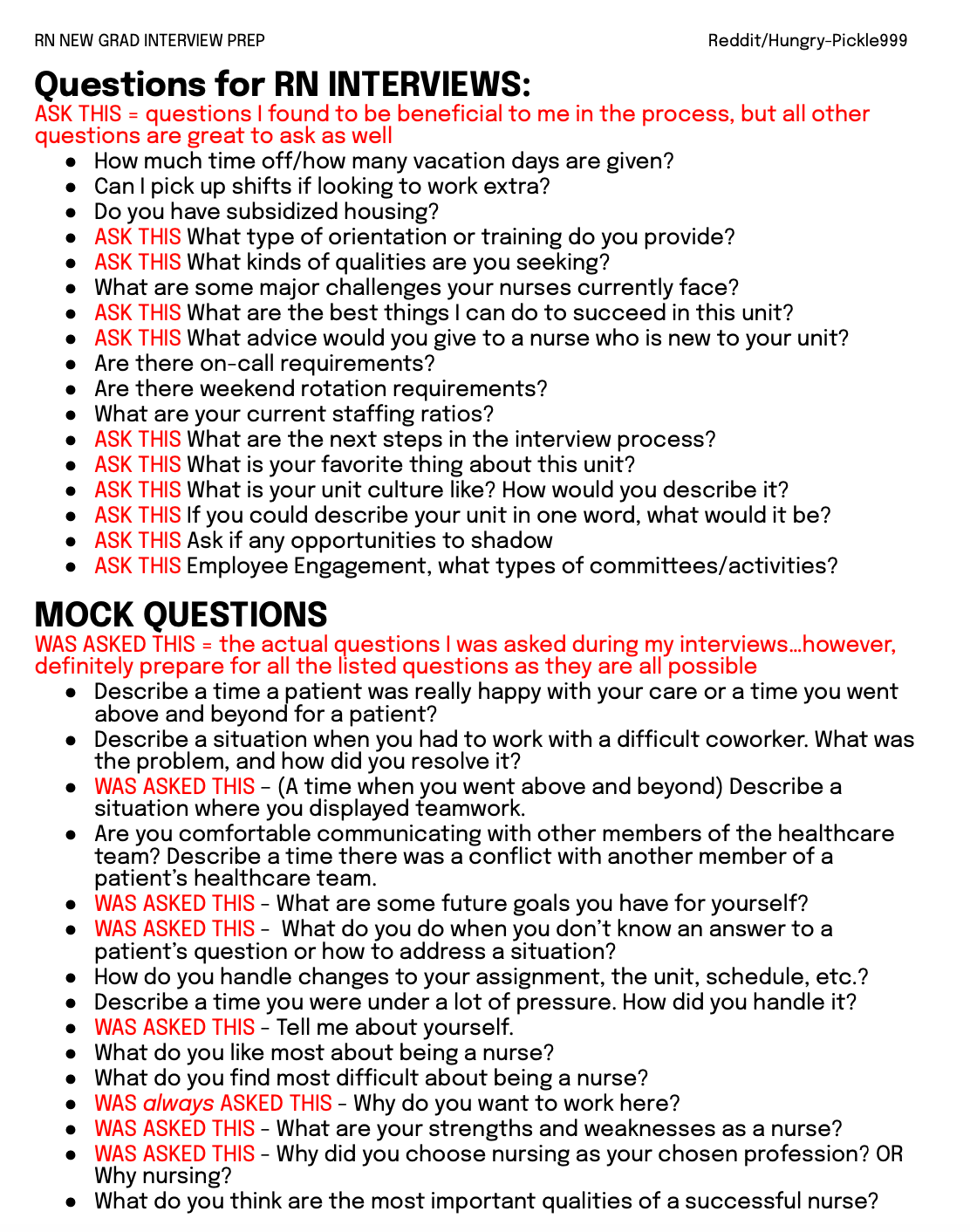
Nursing Interview Questions and Answers: How to Prepare
A nursing interview is an opportunity to show more than clinical knowledge. Employers also want to understand how you communicate, prioritize care, respond to pressure, work with a team, and protect patient safety. Preparing thoughtful answers can help you describe your experience clearly and explain the kind of nurse you hope to be.
Use the sample answers below as starting points, not scripts. The strongest responses are honest, specific, and based on your own experience. If you are a new graduate, draw examples from clinical rotations, simulation labs, volunteer work, or other relevant experience.
How to Structure Your Answers
For questions about past experiences, the STAR method can help keep your answer focused:
- Situation: Briefly describe the context.
- Task: Explain what you were responsible for.
- Action: Describe the steps you took and why.
- Result: Share the outcome and what you learned.
Keep patient information confidential. Avoid names, identifying details, or information that could reveal a patient’s identity. When discussing a clinical situation, focus on your actions, communication, and learning.
Common Nursing Interview Questions and Sample Answers
“Tell me about yourself.”
This question is usually an invitation to summarize your background and explain why the role interests you. Keep your answer relevant to nursing rather than reciting your entire résumé.
Sample answer: “I’m a registered nurse with experience in medical-surgical care, where I’ve developed skills in patient assessment, medication administration, and coordinating care with an interdisciplinary team. I value clear communication and patient education, especially when someone is managing a new diagnosis. I’m interested in this position because it would let me contribute those strengths while continuing to grow in a collaborative setting.”
“Why did you choose nursing?”
Connect your personal motivation to the responsibilities of the profession. Avoid implying that nursing is only about being compassionate; also mention the judgment, teamwork, and accountability the work requires.
Sample answer: “I chose nursing because I wanted a career that combines science, problem-solving, and direct service to people. During my clinical placements, I saw how careful assessment and patient education can make a meaningful difference. I also learned that good nursing depends on teamwork and a willingness to keep learning.”
“Why do you want to work here?”
Research the organization before the interview. You might refer to its patient population, services, community role, or professional development opportunities, as long as your comments are accurate.
Sample answer: “I’m interested in this organization because of its focus on coordinated, patient-centered care. I also appreciate the emphasis on continuing education and collaboration across disciplines. I’m looking for a workplace where I can contribute consistently, learn from experienced colleagues, and support patients through both treatment and recovery.”
“What are your strengths as a nurse?”
Choose two or three strengths that match the position, then support them with a brief example.
Sample answer: “One of my strengths is staying organized when several needs arise at once. I use a structured approach to assess urgency, make a plan, and communicate changes to the team. I’m also attentive to patient education. I check for understanding and adjust my explanation to the patient’s needs rather than assuming that information has been understood.”
“What is an area you’re working to improve?”
Choose a genuine but manageable development area. Explain the practical steps you are taking to improve. Avoid answers that suggest unsafe practice or a refusal to accept feedback.
Sample answer: “I’ve been working on becoming more concise when giving handoff reports. I used to include too much background information, so I’ve been practicing a more structured format that highlights the patient’s current status, important changes, and follow-up needs. I ask for feedback from colleagues so I can keep improving.”
“How do you prioritize care when several patients need you?”
Show that you can reassess, recognize urgent changes, and communicate. Your response should reflect your training, workplace policies, and the support available on the unit.
Sample answer: “I first identify any immediate safety concerns or signs of deterioration, then assess the needs and time sensitivity of the other patients. I organize tasks according to urgency, communicate with the team, and ask for help when appropriate. I continue reassessing because priorities can change quickly. If I’m uncertain, I use the chain of command and follow unit protocols.”
“Tell me about a time you handled a difficult patient or family interaction.”
Demonstrate empathy, respectful communication, and appropriate boundaries. Avoid criticizing the patient or family.
Sample answer: “During a clinical placement, a family member was upset because they did not understand a change in the care plan. I listened without interrupting, acknowledged their concerns, and clarified what I could within my role. I then contacted the appropriate clinician to address the questions I could not answer. The conversation became calmer, and the family received a clearer explanation.”
“Describe a time you made a mistake or caught a potential error.”
Choose an example that you can discuss responsibly. Focus on patient safety, prompt communication, following reporting procedures, and what you changed afterward. Do not minimize or conceal a mistake.
Sample answer: “I once noticed that an order did not match the information I had verified in the patient’s record. I paused before proceeding, checked the relevant details, and contacted the appropriate clinician for clarification. The discrepancy was resolved before the next step in care. The experience reinforced the importance of verification and speaking up whenever something does not seem right.”
“How do you respond to feedback?”
Employers want to know that you can learn and communicate professionally, including when feedback is difficult to hear.
Sample answer: “I try to listen carefully and understand the specific behavior or outcome the feedback addresses. If I need clarification, I ask respectfully. Then I identify a practical change and follow up to see whether I’m improving. Feedback is important in nursing because it supports both professional growth and safe patient care.”
“How do you handle stress during a busy shift?”
Describe concrete habits rather than saying you never feel stressed. Mention prioritization, communication, and seeking support before a situation becomes unsafe.
Sample answer: “I manage a busy shift by staying organized, reassessing priorities, and communicating early when workload or patient needs change. I break larger tasks into clear next steps and use available team support appropriately. After a difficult shift, I reflect on what went well and what I could handle differently next time.”
“Tell me about a time you worked through a disagreement with a colleague.”
Choose a professional example that shows respectful communication and a focus on patient care.
Sample answer: “A colleague and I had different views about the best way to organize a non-urgent task. I asked to discuss the concern privately, listened to their reasoning, and explained my own. We reviewed the patient’s needs and the applicable guidance, then agreed on a plan. If the disagreement had raised a safety concern, I would have escalated it through the appropriate channels.”
“How do you educate a patient who is overwhelmed or unsure?”
Show that you can tailor information, invite questions, and check understanding rather than simply delivering instructions.
Sample answer: “I start by asking what the patient already understands and what concerns them most. I explain the information in plain language, one step at a time, and pause for questions. When appropriate, I use teach-back to check understanding and identify anything that needs to be explained again. I also involve the care team or an interpreter when needed.”
“What would you do if you noticed a patient’s condition changing?”
Emphasize prompt assessment, timely communication, and following the organization’s escalation procedures. Avoid suggesting that you would act outside your scope or wait to see whether a concerning change resolves on its own.
Sample answer: “I would assess the patient promptly, compare the findings with their baseline, and take action within my role and training. I would notify the appropriate clinician and use the unit’s escalation process if the situation required it. I would continue monitoring, document according to policy, and communicate relevant updates to the team.”
“Why should we hire you?”
Summarize the strengths and experience you would bring without overstating your qualifications.
Sample answer: “I bring a strong commitment to safe, respectful care, along with experience communicating with patients and collaborating with a care team. I’m organized, open to feedback, and careful about asking questions when I’m unsure. I would bring a dependable approach to the role and a willingness to keep developing my skills.”
Questions to Ask the Interviewer
Thoughtful questions help you understand the position and show that you are considering how you can contribute. You might ask:
- What does orientation look like for a nurse joining this unit?
- How is staffing and workload typically organized?
- What qualities help nurses succeed on this team?
- How does the unit support continuing education and professional development?
- How are patient safety concerns communicated and addressed?
- What are the next steps in the hiring process?
Tips for a Strong Nursing Interview
- Review the job description. Prepare examples that connect your experience to the role’s responsibilities and required skills.
- Learn about the employer. Read about its services, patient population, and stated values. Use verified details in your answers.
- Prepare several examples. Think of situations involving teamwork, prioritization, patient education, conflict, and learning from feedback.
- Be specific and concise. Give enough detail to make your example meaningful, but keep the focus on your actions and the outcome.
- Be honest about your experience. If you have not encountered a particular situation, explain how you would approach it using your training, policies, and available support.
- Protect confidentiality. Keep patient stories anonymous and share only the details needed to explain your professional response.
- Show that safety comes first. Explain when you would verify information, seek guidance, or escalate a concern.
- Practice aloud. Rehearsing can help you sound clear and composed without making your answers feel memorized.
Final Thoughts
Strong nursing interview answers combine clinical judgment with compassion, accountability, and clear communication. Prepare examples that reflect your real experience, explain what you learned, and connect your approach to safe, respectful patient care. An interview is also your chance to decide whether the position, team, and work environment are a good fit for your professional goals.
5 Benefits of Preparing for Nursing Interview Questions and Answers
- Builds confidence before the interview.
- Helps organize clear, focused answers.
- Highlights patient safety and teamwork.
- Prepares you for common interview topics.
- Makes it easier to share relevant experience.
4 Drawbacks of Sample Nursing Interview Questions and Answers
- Sample answers can sound rehearsed.
- One-size-fits-all answers may not fit every role.
- Interview advice cannot replace clinical experience.
- Some questions may vary by employer.
Builds confidence before the interview.
Reviewing common nursing interview questions and practicing thoughtful answers can build confidence before the interview. Preparation helps you organize your experiences, highlight your strengths, and feel more comfortable discussing challenging situations. Rather than memorizing a script, practice expressing your ideas in your own words so you can respond clearly and naturally when it’s time to meet with the hiring team.
Helps organize clear, focused answers.
Preparing answers to common nursing interview questions helps you organize your thoughts and respond clearly and confidently. Instead of searching for the right words on the spot, you can structure each response around a relevant example, the actions you took, and the outcome. This keeps your answers focused on the interviewer’s question and makes it easier to highlight your skills, judgment, and commitment to patient care.
Highlights patient safety and teamwork.
Nursing interview questions and answers can highlight how a nurse prioritizes patient safety and works as part of a team. Questions about changing patient conditions, medication concerns, or disagreements with colleagues give candidates a chance to explain how they communicate clearly, follow protocols, verify information, and speak up about potential risks. Strong answers show that safe care depends not only on individual judgment but also on collaboration, timely escalation, and shared responsibility.
Prepares you for common interview topics.
Reviewing nursing interview questions and answers prepares you for common topics, such as patient safety, prioritizing care, teamwork, communication, and handling stressful situations. Thinking through these subjects ahead of time helps you organize relevant examples from your experience and respond with greater clarity and confidence during the interview. It also makes it easier to show how your skills and approach align with the role.
Makes it easier to share relevant experience.
Nursing interview questions and sample answers make it easier to share relevant experience by helping you identify examples that match the role. Preparing stories about patient care, teamwork, prioritization, and communication can help you explain what you did, why you did it, and what you learned. This keeps your answers focused and helps employers see how your skills could benefit their team.
Sample answers can sound rehearsed.
Sample answers can be helpful for understanding how to structure a response, but repeating them word for word may make you sound rehearsed or impersonal. Interviewers want to hear about your own experiences, judgment, and communication style—not a memorized script. Use sample answers as a guide, then adapt them with specific examples and natural language so your responses feel authentic.
One-size-fits-all answers may not fit every role.
One drawback of relying on one-size-fits-all nursing interview answers is that they may not reflect the specific role, patient population, or workplace. An answer suited to an emergency department may not highlight the skills needed in a rehabilitation unit or a pediatric clinic. Generic responses can also sound rehearsed and make it harder for interviewers to understand what you would bring to their team. Use sample answers as a starting point, then tailor them with relevant examples from your own experience and the job description.
Interview advice cannot replace clinical experience.
Interview advice can help you organize your thoughts, but it cannot replace hands-on clinical experience. Sample answers and practice may prepare you to explain your approach, yet they cannot provide the judgment developed through real patient care, teamwork, and responding to unexpected situations. Use interview tips as a way to communicate your skills—not as a substitute for building them—and be honest about what you have and have not experienced.
Some questions may vary by employer.
One challenge with nursing interview questions and answers is that questions can vary widely by employer, role, and care setting. A hospital may focus on prioritization and emergency response, while a long-term care facility may emphasize communication with residents and families. Because there’s no single list that covers every interview, prepare flexible examples that demonstrate your clinical judgment, teamwork, patient safety, and communication skills rather than memorizing answers word for word.