
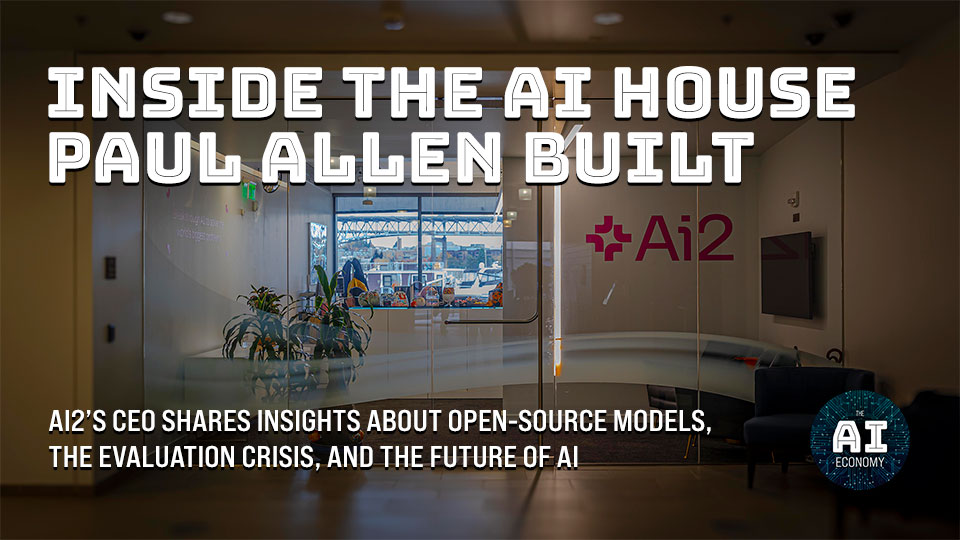
Allen Institute for AI: Advancing Open Artificial Intelligence Research
The Allen Institute for AI, commonly known as Ai2, is a nonprofit research organization based in Seattle, Washington. Founded in 2014 by Microsoft co-founder and philanthropist Paul Allen, the institute advances artificial intelligence through scientific research, open resources, and tools designed to benefit researchers and the broader public.
Ai2’s work spans language models, computer vision, scientific discovery, and AI systems that interpret information across different formats. A defining feature of its approach is an emphasis on openness: helping people understand not only what AI systems can do, but also how those systems are built.
Origins and Mission
Paul Allen established the institute to pursue ambitious AI research with a public-interest mission. Its founding CEO, Oren Etzioni, helped shape an organization focused on fundamental scientific challenges and practical applications.
One of Ai2’s early priorities was developing systems capable of answering science questions. That work required more than identifying keywords. It involved interpreting language, connecting facts, and reasoning about the physical world—challenges that remain important in AI research.
Over time, the institute expanded its scope while maintaining a focus on research that others can examine, use, and build upon.
Major Projects and Contributions
OLMo: Open Language Models
OLMo, short for Open Language Model, is one of Ai2’s most prominent initiatives. First released in 2024, it was designed to make language-model research more transparent by providing access to model weights, training code, data resources, and documentation.
This approach matters because access to a working model alone does not explain how it was developed. Researchers also need information about training methods and data to investigate performance, reproduce experiments, and study potential biases.
OLMo supports that deeper level of investigation, giving the research community a foundation for studying and improving language models.
Dolma: A Resource for Training Research
Dolma is a large collection of text assembled for language-model pretraining. Released alongside the original OLMo effort, it includes material from multiple sources, such as web content, academic publications, code, and reference texts.
Beyond its scale, Dolma is significant because it supports research into how training data affects model behavior. Better documentation and accessible data-processing tools can help researchers evaluate quality, duplication, and other factors that influence AI systems.
Semantic Scholar: Supporting Scientific Discovery
Semantic Scholar is Ai2’s AI-powered research discovery tool. It helps users search scholarly literature, explore citation connections, and identify relevant papers across many fields.
As scientific publishing grows, finding useful research becomes increasingly difficult. Semantic Scholar addresses that challenge by organizing scholarly information and offering features that help users assess relevance more efficiently.
Its research tools and data access also support developers and scholars studying scientific communication.
Molmo: Connecting Vision and Language
Introduced in 2024, Molmo is a family of open multimodal models that combine visual understanding with language capabilities. Such models can answer questions about images and connect written instructions to visible objects or regions.
Multimodal research extends AI beyond text-only interaction. Potential applications include document interpretation, accessibility tools, and systems that help users understand visual information. Reliability, however, still requires careful evaluation.
Tülu and Post-Training Research
Ai2’s Tülu projects explore how pretrained language models can be adapted to follow instructions and produce more useful responses. This stage, often called post-training, can substantially influence a model’s behavior.
Sharing methods and resources for post-training helps researchers examine how instruction data, preference training, and evaluation choices affect results.
Why Ai2’s Open Approach Matters
Advanced AI development can require substantial computing power, specialized expertise, and extensive datasets. Those demands create barriers for universities, smaller organizations, and independent researchers.
Open research resources can lower some of those barriers. They allow more people to test claims, investigate limitations, and develop alternative approaches. They also make it easier to study questions about fairness, safety, efficiency, and reproducibility.
Openness does not automatically make a model accurate, unbiased, or safe. Publicly available systems still require responsible use, rigorous testing, and attention to their limitations. The value of openness lies partly in enabling that scrutiny.
Ai2’s Role in the Future of AI
The Allen Institute for AI occupies an important place between academic research and large-scale industrial development. Its nonprofit structure and emphasis on shared resources support work that can benefit a broad research community.
Through projects such as OLMo, Dolma, Semantic Scholar, Molmo, and Tülu, Ai2 contributes both AI capabilities and ways to study them. Its broader significance lies in advancing a model of AI development built around transparency, scientific investigation, and public benefit.
Allen Institute for AI (Ai2): 7 Frequently Asked Questions
- What is the Allen Institute for AI (Ai2)?
- Who founded the Allen Institute for AI?
- Where is the Allen Institute for AI located?
- What does the Allen Institute for AI research?
- What is OLMo, and how is it related to Ai2?
- Is the Allen Institute for AI a nonprofit organization?
- How can I access Ai2’s research, datasets, and AI tools?
What is the Allen Institute for AI (Ai2)?
The Allen Institute for AI (Ai2) is a nonprofit research organization founded in 2014 by Microsoft co-founder Paul Allen and based in Seattle, Washington. Its mission is to advance artificial intelligence for the benefit of humanity through scientific research, open models, and accessible tools. Ai2 works on areas such as natural language processing, computer vision, and AI for scientific discovery. Notable projects include Semantic Scholar, an AI-powered research discovery tool, and OLMo, a family of open language models designed to support transparent, reproducible research.
Who founded the Allen Institute for AI?
The Allen Institute for AI (Ai2) was founded in 2014 by Paul Allen, the Microsoft co-founder and philanthropist. Based in Seattle, Washington, the nonprofit institute was established to advance artificial intelligence research for the public good. Oren Etzioni served as its founding CEO, helping shape its early research direction.
Where is the Allen Institute for AI located?
The Allen Institute for AI (Ai2) is headquartered in Seattle, Washington, United States. Founded by Microsoft co-founder Paul Allen in 2014, this nonprofit research institute is part of Seattle’s technology and scientific research community.
What does the Allen Institute for AI research?
The Allen Institute for AI (Ai2) researches artificial intelligence, with a focus on natural language processing, computer vision, machine learning, and AI tools for scientific discovery. Its projects include open language models such as OLMo, multimodal models such as Molmo that process images and text, and Semantic Scholar, a tool for finding and exploring academic research. Ai2 also studies training data, model evaluation, and methods for making AI systems more useful and transparent, sharing resources to help the broader research community build on its work.
What is OLMo, and how is it related to Ai2?
OLMo, short for Open Language Model, is a family of open language models developed by the Allen Institute for AI (Ai2), a nonprofit AI research organization. First introduced in 2024, OLMo supports transparent, reproducible research by providing access to model weights, training code, data resources, and documentation. As a major Ai2 initiative, it helps researchers study how language models are built, evaluate their limitations, and develop improvements.
Is the Allen Institute for AI a nonprofit organization?
Yes, the Allen Institute for AI (Ai2) is a nonprofit research organization founded in 2014 by Microsoft co-founder Paul Allen. Based in Seattle, Washington, Ai2 advances artificial intelligence research for the public good, with an emphasis on open models, accessible research tools, and scientific discovery.
How can I access Ai2’s research, datasets, and AI tools?
You can access the Allen Institute for AI’s research, datasets, and AI tools through its official website, allenai.org, where project pages link to publications, documentation, and available resources. Ai2 also shares code on GitHub and model weights and datasets on Hugging Face. To explore scholarly literature, visit Semantic Scholar, which also offers API access for developers. Availability and access requirements vary by resource, so check each project’s license, usage terms, and setup instructions before downloading or integrating it.