AI for Industry: Practical Applications, Benefits, and Challenges
Artificial intelligence is becoming a practical tool for industrial companies seeking to reduce downtime, improve quality, and use resources more efficiently. From detecting equipment faults to helping engineers search technical documentation, AI can support decisions across factories, warehouses, and supply chains.
Its value, however, depends less on the sophistication of a model than on the problem it solves. Successful industrial AI projects combine reliable data, clear business goals, and the expertise of people who understand the operation.
What Is Industrial AI?
Industrial AI refers to the use of artificial intelligence in activities such as manufacturing, energy production, logistics, mining, and infrastructure management. These systems analyze information, identify patterns, and generate predictions or recommendations. In some settings, they also help control equipment within defined operating limits.
Several technologies contribute to these applications:
- Machine learning: Uses historical and current data to identify patterns, estimate outcomes, or detect unusual conditions.
- Computer vision: Analyzes images and video to inspect products, monitor processes, or guide robots.
- Natural language processing and generative AI: Help people search documents, summarize reports, and draft technical content.
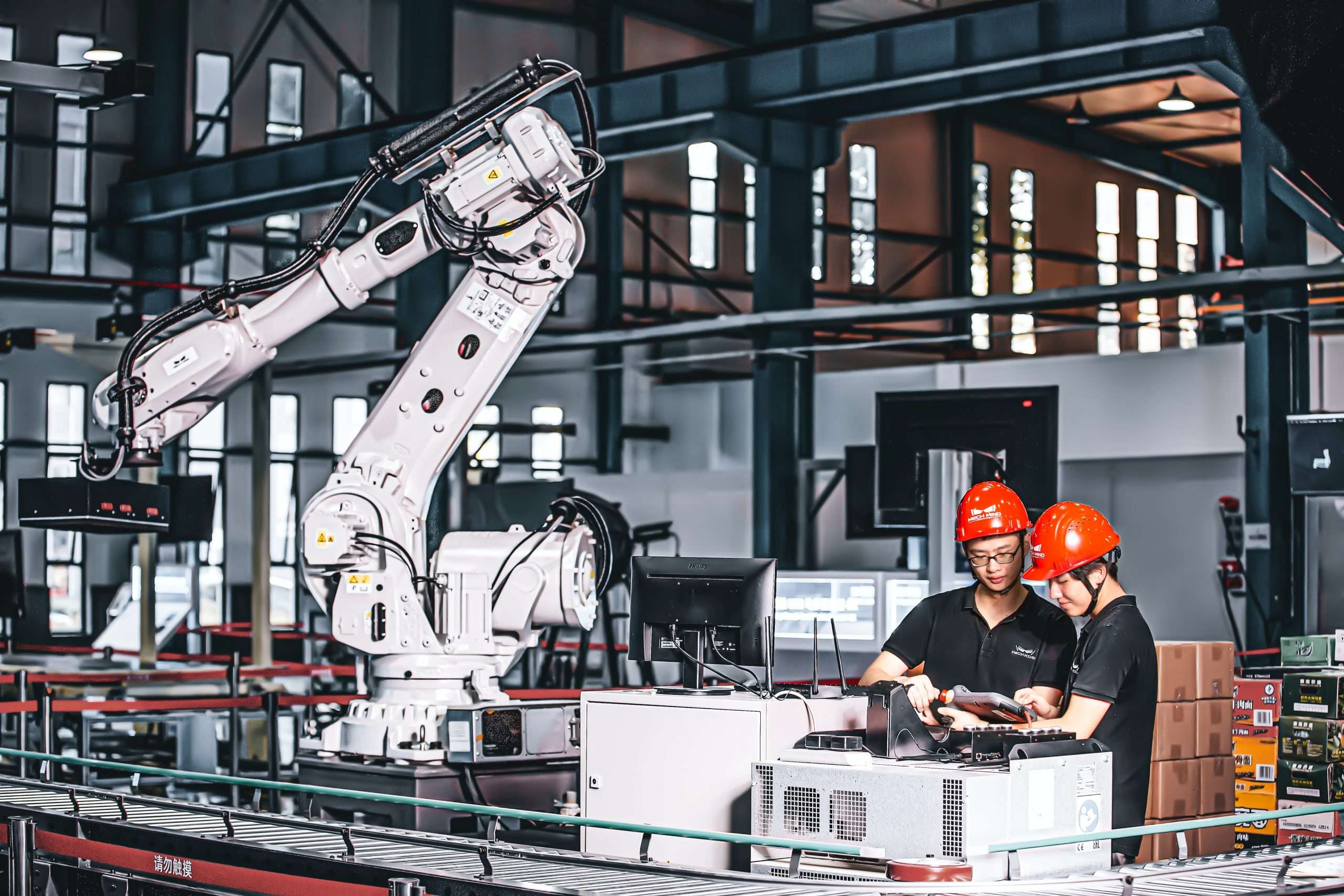
- AI-enabled robotics: Combines sensing, planning, and physical movement to handle tasks that require some adaptability.
AI does not replace every conventional automation system. Fixed rules and established control methods often remain the best choice for stable, well-defined tasks. AI is especially useful when conditions vary or when patterns are difficult to capture with simple rules.
Key Applications of AI in Industry
Predictive Maintenance
Unexpected equipment failures can interrupt production and create costly delays. Predictive maintenance uses data such as vibration, temperature, pressure, and electrical current to identify signs of deterioration.
For example, an AI system may detect changes in a motor’s vibration pattern and flag the equipment for inspection. Maintenance teams can then evaluate the warning and, when appropriate, schedule repairs during a planned shutdown.
These systems are not infallible. False alarms can waste maintenance resources, while missed failures can undermine trust. Their performance should be compared with existing maintenance practices and evaluated under actual operating conditions.
Automated Quality Inspection
Computer vision can help identify surface defects, missing components, incorrect labels, and dimensional inconsistencies. On a packaging line, cameras may check whether seals are intact or whether the correct product information appears on each package.
AI-assisted inspection can provide consistent screening at production speed, but effectiveness depends on image quality, lighting, representative training examples, and clearly defined acceptance criteria. Human inspectors remain important for ambiguous cases and new types of defects.
Process Optimization
Industrial processes often involve interacting variables, including temperature, speed, pressure, and raw material characteristics. AI can analyze these relationships and recommend settings that improve yield, consistency, or resource efficiency.
In a chemical plant, for instance, a model might help operators understand how changing input conditions affect product quality. Recommendations must still respect safety constraints, equipment limits, and regulatory requirements. Direct control requires substantially more validation than advisory use.
Supply Chain and Inventory Planning
AI can support demand forecasting, inventory management, production scheduling, and transportation planning. By analyzing order histories, lead times, and other relevant signals, models can help planners anticipate shortages or excess stock.
Forecasts remain uncertain, particularly during sudden market changes or supply disruptions. Effective planning therefore combines AI-generated estimates with scenario analysis and human judgment.
Energy Management
Industrial facilities can use AI to analyze energy consumption and identify opportunities to reduce waste. Potential applications include detecting inefficient equipment, improving heating and cooling schedules, and shifting flexible operations away from periods of peak electricity demand.
Any claimed savings should be measured against a suitable baseline that accounts for production volume, weather, product mix, and other relevant factors. Lower energy use does not automatically mean lower emissions; the electricity source and timing of consumption also matter.
Technical Knowledge and Workforce Support
Generative AI can make large collections of manuals, maintenance records, and operating procedures easier to navigate. A technician might ask a question in plain English and receive a summary linked to relevant sections of approved documentation.
Because generative systems can produce incorrect information, technical answers should be checked against authoritative sources. Safety-critical instructions require qualified review, and confidential engineering or customer data should only be processed through approved systems.
The Business Benefits of Industrial AI
When applied to an appropriate problem, AI can help companies achieve several operational goals:
- Less unplanned downtime: Earlier identification of equipment problems can support better maintenance scheduling.
- More consistent quality: Inspection and process monitoring can help detect variation before it creates significant waste.
- Better resource use: Improved planning can reduce unnecessary consumption of materials, energy, and production capacity.
- Faster access to information: Search and summarization tools can reduce time spent locating technical knowledge.
- Improved decision support: Predictive models can help teams evaluate options using more information.
These benefits are not guaranteed. Results vary by application, data quality, implementation cost, and the organization’s ability to act on the system’s output.
Challenges Companies Need to Address
Data Quality and Availability
Industrial data is often fragmented across older machines, control systems, spreadsheets, and enterprise software. Sensors may be unreliable, timestamps may not align, and records of failures or defects may be incomplete. Preparing this data can require more effort than developing the model itself.
Integration With Existing Operations
A useful prediction has little value if it does not reach the right person at the right time. AI tools need to fit maintenance workflows, production systems, and established responsibilities without creating unnecessary complexity.
Safety and Cybersecurity
Connecting analytical tools to operational technology can introduce new risks. Organizations should apply appropriate access controls, network segmentation, monitoring, and change management. AI should not bypass independent safety protections, and failures should leave equipment in a safe state.
Workforce Skills and Trust
Operators, engineers, and maintenance technicians understand conditions that may not appear in a dataset. Involving them early helps teams select useful applications, interpret results, and identify failure modes. Training should explain both what the system can do and when its output should be questioned.
Model Performance Over Time
Equipment ages, suppliers change, and production processes evolve. A model that performed well during testing may become less accurate later. Ongoing monitoring, periodic validation, and clear responsibility for updates are essential.
How to Start an Industrial AI Project
- Define a specific problem. Focus on a measurable issue, such as recurring downtime on one production line or a high rate of a particular defect.
- Establish a baseline. Document current performance so that any improvement can be evaluated fairly.
- Check whether AI is necessary. Compare it with simpler alternatives, including better sensors, revised procedures, statistical methods, or conventional automation.
- Assess data and operational readiness. Confirm that relevant data is available and that teams can act on the results.
- Run a controlled pilot. Test under representative conditions, initially in advisory or shadow mode when appropriate.
- Measure the full impact. Include integration, infrastructure, training, maintenance, and error costs—not just model accuracy.
- Scale with oversight. Expand only after the system demonstrates reliable value, with clear ownership and fallback procedures.
The Future of AI for Industry
Industrial AI is expanding toward systems that combine sensor readings, images, technical documents, and operational records. Processing data closer to equipment can also support applications that need low latency or limited connectivity.
Even as these tools improve, industrial requirements remain demanding. Reliability, safety, maintainability, and measurable returns matter more than novelty.
The strongest approach is to treat AI as part of an operational improvement strategy rather than as a goal in itself. By starting with a clear problem, involving experienced workers, and validating results carefully, industrial companies can identify where AI adds value—and where simpler solutions remain the better choice.
5 Practical Tips for Successfully Adopting AI in Industry
- Start with a clear, measurable business problem.
- Use high-quality data and protect sensitive information.
- Pilot AI on a small scale before expanding.
- Keep human oversight for important decisions.
- Track performance, costs, and risks over time.
Start with a clear, measurable business problem.
Start with a clear, measurable business problem rather than adopting AI simply because it is available. Identify a specific operational challenge, such as unplanned equipment downtime, high defect rates, or excessive energy consumption, and establish a baseline using current performance data. Then set a realistic target, such as reducing downtime on a particular production line by 10% within six months. This focus helps determine whether AI is the right solution, which data is needed, and how success will be measured. Involve operators, engineers, and business leaders early to ensure the project addresses a real need and delivers practical value.
Use high-quality data and protect sensitive information.
High-quality data is essential for reliable industrial AI. Make sure the information is accurate, consistent, up to date, and representative of real operating conditions before using it to train or evaluate a system. At the same time, protect sensitive business, employee, and customer information with access controls, encryption, and clear data-handling rules. Use only approved tools, and avoid sharing confidential data with systems that have not been reviewed for security and privacy.
Pilot AI on a small scale before expanding.
Piloting AI on a small scale helps industrial companies test its value before committing to a broader rollout. Start with a clearly defined use case, such as detecting defects on one production line or monitoring a single machine for signs of failure. Set measurable goals, establish a performance baseline, and involve operators and maintenance teams to assess how the tool fits existing workflows. Track benefits alongside costs, false alarms, and integration challenges, while keeping appropriate human oversight and safety controls in place. Use the results to refine the approach and expand only when the pilot demonstrates reliable, repeatable value.
Keep human oversight for important decisions.
Keep human oversight in place when using AI for important industrial decisions, especially those involving worker safety, equipment operation, product quality, or regulatory compliance. AI can detect patterns and recommend actions, but its output may be inaccurate or miss critical context. Qualified employees should review high-impact recommendations, verify them against reliable data and established procedures, and have the authority to reject or override them. Clear approval steps, decision records, and escalation procedures help ensure accountability while allowing teams to benefit from AI’s speed and analytical capabilities.
Track performance, costs, and risks over time.
Track performance, costs, and risks over time to ensure industrial AI continues to deliver value as operating conditions change. Monitor metrics such as prediction accuracy, downtime, defect rates, and energy use against established baselines, while accounting for changes in production volume or product mix. Include ongoing expenses such as software, computing, maintenance, and employee training—not just the initial investment. Regularly review safety, cybersecurity, and data quality risks, and set clear thresholds for investigating problems, updating models, or pausing the system. Assigning responsibility for these reviews helps teams catch declining performance early and make informed decisions about continued use or expansion.