The Development of Artificial Intelligence: A Journey Through Innovation
Artificial intelligence (AI) has rapidly evolved from a theoretical concept to an integral part of modern technology. Its development has been marked by significant milestones, each contributing to the sophisticated systems we interact with today.
Early Beginnings
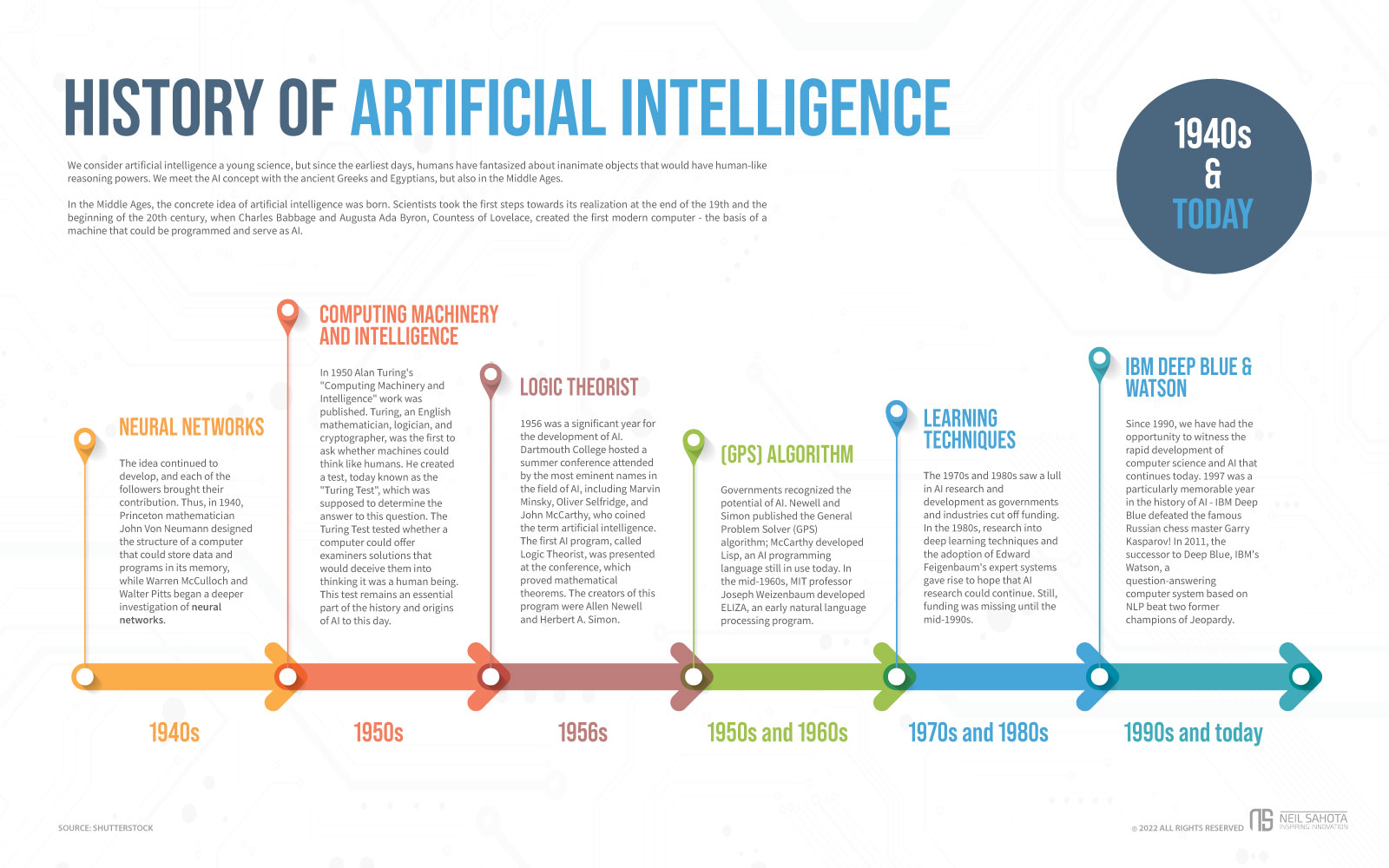
The concept of machines simulating human intelligence dates back to ancient history, but it wasn’t until the mid-20th century that AI began to take shape. In 1956, the Dartmouth Conference marked a pivotal moment, coining the term “artificial intelligence” and setting the stage for future research.
Key Milestones
- 1960s – 1970s: The development of algorithms and programming languages like LISP laid the foundation for early AI research. During this period, researchers focused on problem-solving and symbolic reasoning.
- 1980s: The rise of expert systems brought AI into commercial applications. These systems used rule-based logic to mimic human decision-making in specific domains.
- 1990s: With advancements in computational power, AI experienced a resurgence. Notably, IBM’s Deep Blue defeated world chess champion Garry Kasparov in 1997, showcasing AI’s potential in complex tasks.
- 2000s – Present: The advent of big data and machine learning revolutionized AI development. Neural networks and deep learning algorithms enabled breakthroughs in natural language processing, image recognition, and more.
The Role of Machine Learning
Machine learning has been central to AI’s progress. By allowing systems to learn from data rather than relying on explicit programming, machine learning models have improved their accuracy over time. This approach has led to significant advancements in areas such as speech recognition and autonomous vehicles.
Current Applications
Today, AI is embedded in numerous facets of daily life. Virtual assistants like Siri and Alexa use natural language processing to understand user commands. In healthcare, AI aids in diagnostics by analyzing medical images with high precision.
The Impact on Industries
- Finance: AI algorithms detect fraudulent transactions and assist with investment strategies through predictive analytics.
- E-commerce: Personalized recommendations driven by machine learning enhance customer experiences on platforms like Amazon and Netflix.
- Agriculture: AI-powered drones monitor crop health and optimize resource usage for sustainable farming practices.
The Future of Artificial Intelligence
The future promises even greater integration of AI into society. As research continues into areas such as general artificial intelligence (AGI) and ethical considerations grow more prominent, ensuring responsible development will be key. The potential for AI to transform industries is immense, but it must be balanced with considerations for privacy, security, and societal impact.
The development of artificial intelligence is an ongoing journey filled with challenges and opportunities. As technology advances, so does the promise of a future where intelligent machines enhance human capabilities across diverse fields.
9 Frequently Asked Questions About the Development of Artificial Intelligence
- Who first created artificial intelligence?
- What are the major developments in artificial intelligence?
- What is the development of AI?
- Did Elon Musk invent OpenAI?
- Which 3 jobs will survive AI?
- What is development of artificial intelligence?
- What is the development of artificial intelligence?
- When did AI begin to be developed?
- Who is the developer of artificial intelligence?
Who first created artificial intelligence?
The creation of artificial intelligence cannot be attributed to a single individual, as it was the result of collaborative efforts by several pioneering researchers. However, one key figure often associated with the inception of AI is John McCarthy, who is credited with coining the term “artificial intelligence” in 1956. McCarthy organized the Dartmouth Conference that same year, which is considered the founding event of AI as a field of study. Alongside McCarthy, other notable contributors included Marvin Minsky, Allen Newell, and Herbert A. Simon, who collectively laid the groundwork for AI by exploring concepts such as machine learning, neural networks, and symbolic reasoning. These early innovators set the stage for decades of research and development that have shaped AI into what it is today.
What are the major developments in artificial intelligence?
Artificial intelligence has seen several major developments over the years, significantly transforming technology and society. One of the most prominent advancements is the rise of machine learning and deep learning, which have enabled computers to learn from vast amounts of data and improve their performance over time. This has led to breakthroughs in natural language processing, allowing AI systems to understand and generate human language more effectively, as seen in applications like chatbots and virtual assistants. Another significant development is in computer vision, where AI can now accurately recognize and interpret visual information, powering innovations in fields such as autonomous vehicles and facial recognition technology. Additionally, AI’s integration into robotics has advanced automation across industries, enhancing efficiency and precision in manufacturing, healthcare, and beyond. These developments collectively showcase AI’s growing capability to tackle complex problems and its potential to revolutionize various sectors.
What is the development of AI?
The development of artificial intelligence (AI) refers to the process of designing and creating systems that can perform tasks typically requiring human intelligence. This includes activities such as learning, reasoning, problem-solving, perception, and language understanding. The development journey began in the mid-20th century with foundational theories and algorithms, gradually evolving through various technological advancements like machine learning and neural networks. Today, AI development encompasses a wide range of applications across industries, from virtual assistants and autonomous vehicles to advanced data analytics in healthcare and finance. As AI continues to progress, it is driven by innovations in computational power, data availability, and algorithmic improvements, all while addressing ethical considerations and societal impacts.
Did Elon Musk invent OpenAI?
Elon Musk did not invent OpenAI, but he was one of its co-founders and early supporters. OpenAI was established in December 2015 with the mission to ensure that artificial general intelligence (AGI) benefits all of humanity. The organization was founded by a group that included Elon Musk, Sam Altman, Greg Brockman, Ilya Sutskever, Wojciech Zaremba, and John Schulman. While Elon Musk played a significant role in its inception by providing financial backing and helping to shape its initial vision, he stepped away from the board in 2018 to avoid any potential conflict of interest with his work at Tesla. OpenAI continues to operate as an independent research organization focused on advancing AI technology responsibly.
Which 3 jobs will survive AI?
As artificial intelligence continues to evolve and automate various tasks, certain jobs are more likely to withstand the shift due to their reliance on uniquely human skills. Firstly, roles in the creative industries, such as artists, writers, and musicians, are expected to survive because they require original thought and emotional expression that AI cannot replicate. Secondly, professions that demand high levels of interpersonal interaction and empathy, such as therapists and social workers, are likely to endure since these roles rely on human connection and nuanced understanding. Finally, jobs in complex strategic decision-making positions, like senior management or specialized consultants, will persist because they involve intricate problem-solving and judgment that machines have yet to master fully. These areas highlight the importance of creativity, emotional intelligence, and strategic thinking in an AI-driven future.
What is development of artificial intelligence?
The development of artificial intelligence (AI) refers to the process of creating systems and technologies that can perform tasks typically requiring human intelligence. This includes activities such as learning, reasoning, problem-solving, perception, and language understanding. The development journey involves designing algorithms and models that enable machines to process data, recognize patterns, and make decisions. Over the years, advancements in computational power and data availability have accelerated AI’s growth, leading to applications across various industries like healthcare, finance, and transportation. The goal is to create intelligent systems that can improve efficiency, enhance decision-making, and augment human capabilities while addressing ethical considerations and potential societal impacts.
What is the development of artificial intelligence?
The development of artificial intelligence (AI) refers to the ongoing process of creating systems and technologies that can perform tasks typically requiring human intelligence. This includes learning from data, recognizing patterns, making decisions, and understanding natural language. AI development encompasses a variety of techniques such as machine learning, neural networks, and deep learning, which enable computers to improve their performance over time without explicit programming. The field has evolved significantly since its inception in the mid-20th century, driven by advances in computational power and data availability. Today, AI is applied across numerous industries, enhancing capabilities in areas like healthcare diagnostics, financial analysis, autonomous vehicles, and personalized customer experiences. As AI continues to develop, it promises to further transform how we live and work while raising important ethical and societal considerations.
When did AI begin to be developed?
The development of artificial intelligence (AI) began in earnest during the mid-20th century. The field was formally established in 1956 at the Dartmouth Conference, where the term “artificial intelligence” was coined. This conference brought together researchers who were interested in the possibility of creating machines that could simulate aspects of human intelligence, such as learning and problem-solving. Prior to this, there had been theoretical discussions and early work on intelligent machines, but it was at this point that AI became a distinct area of study with dedicated research efforts. The subsequent decades saw significant advancements in algorithms and computational techniques that laid the groundwork for modern AI systems.
Who is the developer of artificial intelligence?
The development of artificial intelligence (AI) cannot be attributed to a single individual, as it is the result of contributions from numerous researchers, scientists, and innovators over several decades. The field of AI began to take shape in the mid-20th century, with pivotal figures such as John McCarthy, who coined the term “artificial intelligence” and organized the Dartmouth Conference in 1956, widely regarded as the founding event of AI research. Other key contributors include Alan Turing, whose work laid the groundwork for machine learning concepts, and Marvin Minsky, who made significant strides in AI programming and robotics. Collectively, these pioneers and many others have advanced AI through collaborative efforts across academic institutions and tech companies worldwide.