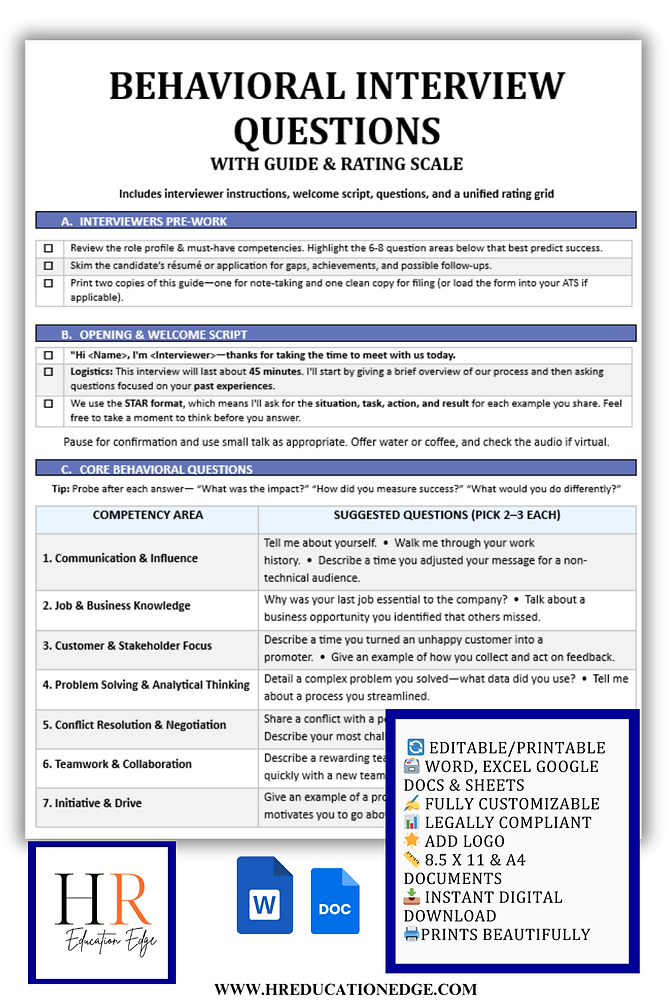
The Power of Behavioral Questions in Interviews
Behavioral questions have become a cornerstone of modern job interviews, and for good reason. Unlike traditional questions that focus on hypothetical scenarios or generic skills, behavioral questions delve into past experiences to predict future behavior. By asking candidates to provide specific examples of how they handled situations in the past, employers gain valuable insights into their potential performance.
Understanding Behavioral Questions
Behavioral questions are designed to uncover how candidates have demonstrated key competencies in real-life situations. For example, instead of asking, “How do you handle conflict?” a behavioral question might be, “Tell me about a time when you had a disagreement with a coworker and how you resolved it.” This approach forces candidates to draw on concrete experiences, providing interviewers with tangible evidence of their abilities.
The Benefits of Using Behavioral Questions
Employers who incorporate behavioral questions into their interviews reap numerous benefits. Firstly, these questions help assess a candidate’s fit for the role by evaluating their past behavior in relevant contexts. Additionally, behavioral questions encourage candidates to be more authentic and provide concrete examples rather than relying on vague or rehearsed responses.
Tips for Answering Behavioral Questions
When faced with behavioral questions during an interview, candidates should follow some key strategies:
- Be Specific: Provide detailed examples that showcase your skills and experiences.
- Use the STAR Method: Structure your responses by outlining the Situation, Task, Action, and Result of each scenario.
- Show Growth: Highlight how you learned from past challenges and improved your approach over time.
- Be Honest: Authenticity is key; avoid embellishing or fabricating stories.
In Conclusion
Behavioral questions offer a powerful tool for employers seeking to make informed hiring decisions. By digging into candidates’ past behaviors and actions, interviewers can better predict their future performance and fit within the organization. Likewise, job seekers can leverage behavioral questions as opportunities to showcase their skills and experiences effectively. Embracing this approach can lead to more insightful interviews and successful candidate selections.
6 Benefits of Behavioral Questions: Uncovering True Potential and Predicting Success
- Reveals candidates’ actual behaviors in past situations
- Provides concrete examples of skills and competencies
- Helps assess candidates’ fit for the role more accurately
- Encourages authenticity and honesty in responses
- Allows interviewers to predict future performance based on past actions
- Enables candidates to showcase their growth and learning experiences
5 Drawbacks of Behavioral Interview Questions: Limitations and Challenges
- May not accurately reflect a candidate’s potential for growth or change.
- Candidates may feel pressured to provide ‘perfect’ examples, leading to inauthentic responses.
- Some candidates may lack relevant past experiences to draw upon, putting them at a disadvantage.
- Interviewers may misinterpret or misjudge candidates’ responses, leading to biased evaluations.
- Behavioral questions can be time-consuming during interviews, potentially limiting the scope of discussion.
Reveals candidates’ actual behaviors in past situations
Behavioral questions excel in revealing candidates’ actual behaviors in past situations, providing valuable insights into how individuals have navigated challenges and demonstrated key competencies. By prompting candidates to recount specific experiences and actions they have taken, employers gain a clearer understanding of how candidates are likely to perform in similar scenarios in the future. This approach goes beyond theoretical responses, offering a concrete look into candidates’ real-world problem-solving skills, decision-making processes, and interpersonal interactions. Ultimately, by uncovering candidates’ authentic behaviors through behavioral questions, employers can make more informed hiring decisions based on tangible evidence rather than conjecture.
Provides concrete examples of skills and competencies
One significant advantage of behavioral questions is their ability to elicit concrete examples of an individual’s skills and competencies. By prompting candidates to recount specific instances where they applied certain abilities in real-world scenarios, employers gain a clearer understanding of the candidate’s capabilities. These examples offer tangible evidence of how a candidate has successfully demonstrated key competencies in the past, providing valuable insights into their potential performance in future roles.
Helps assess candidates’ fit for the role more accurately
One significant advantage of using behavioral questions in interviews is their ability to help assess candidates’ fit for the role more accurately. By prompting candidates to share specific examples of their past experiences and actions, employers can gain valuable insights into how well-suited a candidate is for the position. This approach allows interviewers to evaluate not only the candidate’s skills and qualifications but also their behavioral tendencies and problem-solving approaches in real-world scenarios relevant to the role. Ultimately, by focusing on concrete examples of past behavior, behavioral questions enable a more precise assessment of a candidate’s potential performance within the organization.
Encourages authenticity and honesty in responses
Behavioral questions, by nature, encourage authenticity and honesty in responses from candidates during interviews. By prompting individuals to draw on real-life experiences and provide specific examples of their actions and behaviors, these questions discourage vague or scripted answers. Candidates are more likely to showcase their true capabilities and character when recounting genuine situations they have encountered. This authenticity not only helps employers gain a clearer understanding of the candidate’s skills and suitability for the role but also fosters a more transparent and meaningful exchange between the interviewer and interviewee.
Allows interviewers to predict future performance based on past actions
One significant advantage of utilizing behavioral questions in interviews is the ability it provides interviewers to predict future performance by examining candidates’ past actions. By delving into specific examples of how candidates have handled various situations in the past, employers can gain valuable insights into their problem-solving skills, decision-making abilities, and interpersonal competencies. This predictive aspect of behavioral questions enables interviewers to assess how candidates are likely to perform in similar scenarios within the role they are applying for, ultimately leading to more informed hiring decisions and increased likelihood of selecting individuals who can thrive in the position.
Enables candidates to showcase their growth and learning experiences
Behavioral questions provide candidates with a valuable opportunity to showcase their growth and learning experiences. By prompting candidates to share specific examples of how they have navigated challenges and evolved over time, these questions allow individuals to demonstrate their capacity for self-improvement and adaptability. Candidates can highlight how they have learned from past mistakes, developed new skills, and refined their approaches based on feedback and experiences. This aspect of behavioral questions not only illuminates candidates’ personal development but also gives employers insight into their potential for continuous growth within a role.
May not accurately reflect a candidate’s potential for growth or change.
One significant drawback of behavioral questions in interviews is their limitation in accurately reflecting a candidate’s potential for growth or change. By focusing on past behaviors and experiences, these questions may overlook a candidate’s capacity for learning, adapting, and evolving over time. Individuals who have demonstrated growth and development in their skills and attitudes may not fully showcase this aspect when confined to discussing historical scenarios. This con highlights the importance of complementing behavioral questions with inquiries that assess a candidate’s willingness and ability to learn, improve, and embrace change in a dynamic work environment.
Candidates may feel pressured to provide ‘perfect’ examples, leading to inauthentic responses.
One notable drawback of behavioral questions in interviews is that candidates may feel compelled to present idealized or ‘perfect’ examples from their past experiences. This pressure to showcase flawless responses can lead to inauthenticity, as candidates may exaggerate or embellish their stories to meet perceived expectations. This phenomenon not only undermines the genuine nature of the interview process but also hinders the ability of employers to assess candidates accurately. By prioritizing polished narratives over genuine reflections, candidates risk sacrificing authenticity for the sake of meeting perceived standards, ultimately detracting from the overall effectiveness of behavioral questions in evaluating true capabilities and fit.
Some candidates may lack relevant past experiences to draw upon, putting them at a disadvantage.
In the realm of behavioral questions, a significant drawback arises when some candidates find themselves at a disadvantage due to a lack of relevant past experiences to draw upon. This limitation can hinder their ability to provide concrete examples that effectively showcase their skills and competencies. In such cases, candidates may struggle to demonstrate their suitability for the role based on past behaviors, potentially leading to missed opportunities for them to shine during the interview process.
Interviewers may misinterpret or misjudge candidates’ responses, leading to biased evaluations.
One significant con of behavioral questions in interviews is the potential for interviewers to misinterpret or misjudge candidates’ responses, resulting in biased evaluations. Interviewers may bring their own preconceptions or biases into the evaluation process, leading them to misconstrue a candidate’s experiences or responses. This can result in unfair assessments and hinder the selection of the most qualified candidates based on their actual capabilities. To mitigate this risk, interviewers must undergo training to recognize and address their biases, ensuring that candidates are evaluated objectively and fairly.
Behavioral questions can be time-consuming during interviews, potentially limiting the scope of discussion.
Behavioral questions, while valuable in assessing candidates’ past experiences and behaviors, can present a significant drawback during interviews due to their time-consuming nature. Delving into specific examples and asking candidates to recount detailed scenarios may consume a considerable portion of the interview time, potentially restricting the opportunity for broader discussions on other important topics. This limitation could hinder the exploration of additional skills, qualifications, or cultural fit aspects that could be crucial in evaluating a candidate comprehensively within the allotted interview timeframe. Balancing the depth of behavioral questions with the need for a well-rounded assessment remains a challenge for interviewers seeking to make informed hiring decisions efficiently.